
The Comparison of Battery-Swapping vs Fast-Charging Models for Electric Port Equipment
Throughout 2026, members of PEMA’s Board of Directors will offer their perspectives on the ports industry, covering a variety of topics aligned with their professional specialities.

Continuing our series is Aqwa Chen, who offers his perspective on the topic of battery swapping vs fast-charging models for electric port equipment
Aqwa Chen is is a Deputy General Manager at ZPMC Port Machinery Group where he has worked for almost 20 years as part of the Industrial Machinery and Equipment Industry.
Nowadays the decarbonisation is more and more important for container terminals, especially for those hub and automation terminals. And AGV is one of the most popular solutions for the horizontal transportation system in the automation terminals. The AGVs are powered by battery while currently there are 2 different methods for charging of the battery. Different terminals may choose different methods which depending on the terminal layout design and other facility conditions. This article makes a brief comparison of the 2 different charging methods, battery-swapping(called BS) vs fast-charging (called FC).
AGV power units are usually equipped with pure lithium battery systems, supporting various energy replenishment methods. The BS mode involves removing and replacing the entire vehicle battery pack, while the FC mode involves recharging the on-board battery during the idling time when the AGV is in operation.
Advantages and Disadvantages of BS Mode
Advantages
- Extremely high energy replenishment efficiency, zero operational waiting. The BS time for a single AGV is typically 3–8 minutes, much shorter than the charging time. AGVs experience almost no downtime, maximizing equipment availability and perfectly matching the uninterrupted container handling demands of terminals, especially suitable for large hub ports with high throughput and saturated vehicle flow.
- Optimal vehicle turnaround efficiency. AGVs do not need to occupy recharging berths for long periods. A single battery swap station can serve a large number of AGVs, with high berth utilization and no congestion in recharging lines.
- Controllable battery life, balanced wear. Batteries are stored centrally, maintained uniformly, and managed under constant temperature, avoiding the high-current impact of on-board fast charging. Battery rotation in echelons allows mixing old and new batteries, extending overall battery life and ensuring more even degradation.
- Distributed load, low grid impact. BS operations are carried out in different time periods, with low instantaneous power draw per device. The existing power distribution system of the terminal requires little modification, without significant upgrades to transformers or cables.
- Fault isolation, convenient maintenance. Faulty batteries can be removed and replaced directly, allowing AGVs to resume operation quickly. Battery inspection, maintenance, and servicing are all concentrated at the swap station, eliminating the need to check on-board equipment individually, making it suitable for large-scale fleet management.
Disadvantages
- High initial investment cost. Requires swap robots, swap bays, battery storage, fire protection systems, temperature control systems, and a battery management platform. Many hardware facilities require significant one-time investment in civil works, equipment, and site.
- Large footprint. Requires dedicated planning of a swap workshop/area, battery stacking area, and transfer access. There are strict requirements for the terminal’s layout and available space. Older or retrofitted terminals may be space-constrained.
- Increased battery inventory. Using a “vehicle-battery separation” model requires a stock of spare battery packs. The total number of batteries purchased is higher than in the FC solution, increasing battery asset investment.
- Complex mechanical structure, more maintenance points. Both the AGV body and the swap station need precise docking mechanisms, increasing the probability of mechanical wear, positioning deviation, and jamming faults. A dedicated mechanical maintenance team is required.
- High difficulty in vehicle-battery matching management. Requires a professional Battery Management Systemto unify scheduling and manage the state of charge, state of health, and other parameters of a large number of battery packs, demanding higher information management capabilities.
Advantages and Disadvantages of FC Mode
Advantages
- Simple system architecture, low initial investment. No need for swap mechanisms, battery storage, or swap robots. Only requires high-power charging piles and charging berths. Fewer equipment items, simpler civil works, and overall construction cost significantly lower than the BS mode.
- Small footprint, flexible layout. Charging piles can be scattered along AGV travel routes, at yard edges, or in maintenance areas. No need for a large dedicated area. Highly adaptable for older terminals or those with limited space.
- Streamlined equipment structure, low failure rate. AGVs have no additional mechanical interfaces for BS. The vehicle body structure is simpler, with fewer mechanical faults. Daily maintenance focuses mainly on electrical systems and battery inspections, requiring fewer maintenance personnel.
- Simple asset model, light management. Batteries are permanently mounted on vehicles (vehicle-battery integration), with clear asset ownership. No need for large spare battery inventory, simplifying material management and inventory processes.
Disadvantages
- Long recharging time, reduced equipment availability. Mainstream high-power FC still takes 20–40 minutes per AGV. AGVs must occupy charging berths for extended periods. During peak hours, queues and congestion easily occur, directly reducing terminal transfer efficiency.
- High-current FC damages batteries, accelerating degradation. Continuous high-current charging exacerbates lithium battery heating and polarization, shortening cycle life. Over the long term, battery replacement frequency increases, raising the total lifetime electricity cost.
- High instantaneous grid load, significant power distribution modification pressure. Simultaneous FC of multiple AGVs creates peak load spikes, requiring significant upgrades to transformers, high and low voltage cables, and switchgear. Some older terminals may have grids unable to bear the load, with high modification costs.
- High occupancy rate of charging berths. Charging berths are occupied by vehicles for long periods. For the same number of berths, the number of AGVs that can be served is much lower than in the BS mode. Large fleets require adding many more charging berths.
- Concentrated thermal management risk. On-board batteries experience significant temperature rise during FC, increasing the risk of thermal runaway for individual vehicles. Vehicles are spread out, making fire protection and temperature control more difficult than with centralized swap stations.
Comprehensive Comparison Table of Key Factors
| Item | Battery Swapping Mode | Fast Charging Mode |
|---|---|---|
| Charging Time | 3-8 min | 20-40 min |
| Investment | Hign | Low |
| Space Requirement | Large | Small |
| Battery Lifetime | Long | Short |
| Grid Load | Steady | High |
| Vehicle Failure Rate | High | Low |
| Maintenance Requirement | Hard | Easy |
| Vehicle Utilisation | High | Low |
Summary and Recommendations
- From an operational efficiency perspective: BS is better than FC. For high-load terminals, prioritize is on BS. This is the mainstream energy replenishment solution for large automated container terminals worldwide.
- From an investment and implementation perspective: FC is better than BS. For retrofitting older sites or smaller-scale projects, prioritize is on FC for fast deployment and low entry barrier.
- From a long-term operational perspective:The higher the throughput and the longer the service life, the greater the overall cost-effectiveness of the BS mode. For short-term trials or small-scale applications, FC mode is more pragmatic.
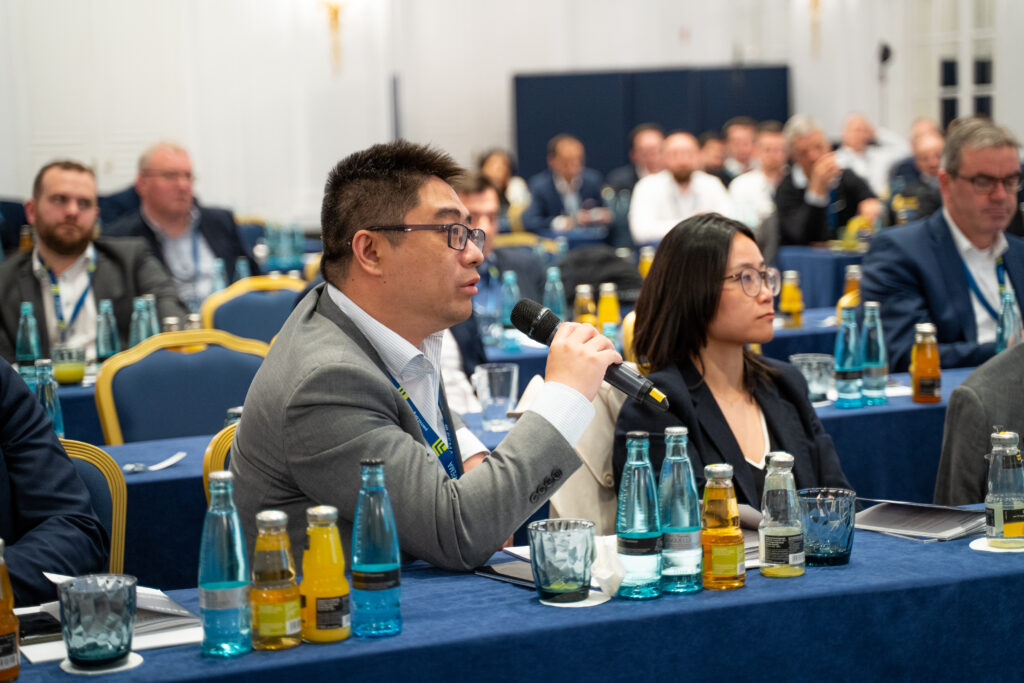
We thank PEMA Board Member, Aqwa Chen for taking the time to compose this insightful piece on battery swapping and fast-charging methods for electrified ports.
Connecting Minds. Leading the Industry.
Port Equipment Manufacturers Association (PEMA)