
Balancing standardisation and terminal-specific design in mobile harbour cranes
Throughout 2026, members of PEMA’s Board of Directors will offer their perspectives on the ports industry, covering a variety of topics aligned with their professional specialities.
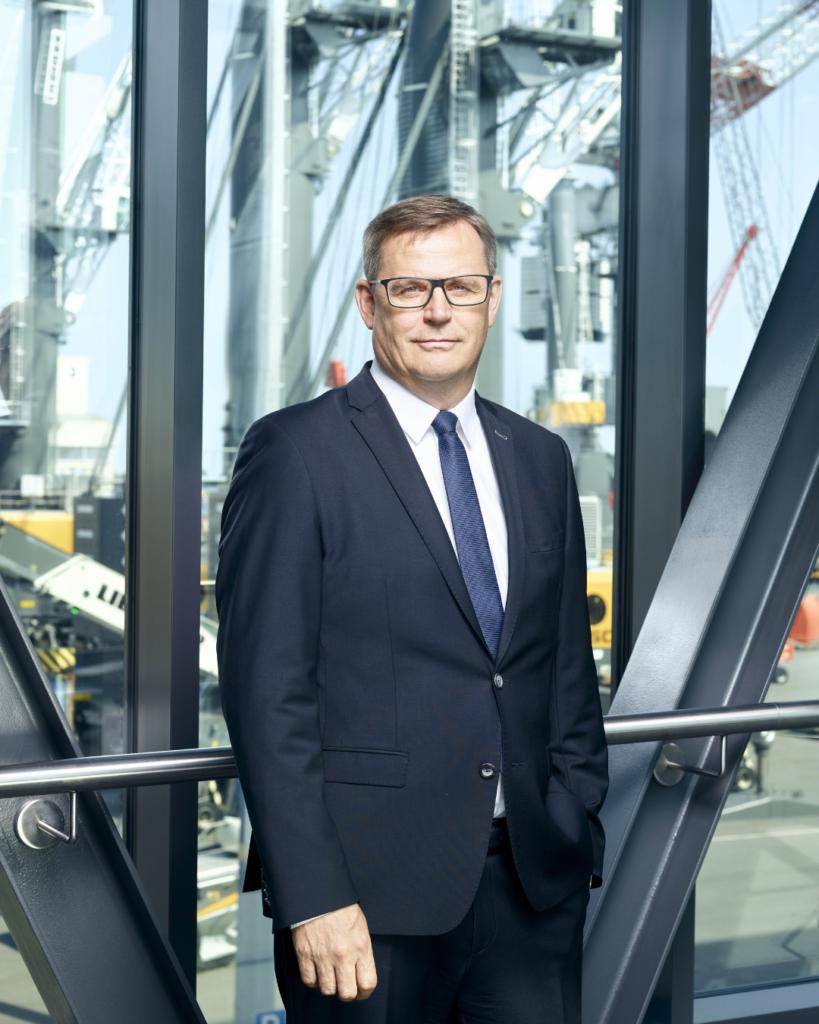
Next in our series is Leopold Berthold, offering his perspective on the topic of balancing standardisation and terminal-specific design in mobile harbour cranes.
Leopold Berthold is an experienced executive in the maritime equipment industry. He currently serves as Managing Director, Liebherr-MCCtec GmbH.
Prior to his current position, Berthold was Managing Director of Maritime Cranes at Liebherr-Werk Nenzing GmbH. His professional background also includes experience in public service, having served as an economic spokesperson and as a member of the State Parliament. He holds a business education from Commercial Academy Bludenz and completed his military service in 1988/89.
Balancing standardisation and terminal-specific design in mobile harbour cranes
Every terminal asks a different question of the crane. One operator may need a mobile machine that can move between berths and switch from containers to bulk. Another may require a rail-mounted portal solution shaped around existing quay infrastructure. A third may handle heavy project cargo in a narrow operating window, where outreach, lifting curve and cycle reliability decide the commercial result. For crane manufacturers, this variety creates a precise engineering challenge: how much of the machine can remain standard, and where should terminal-specific variation be allowed to enter?
The answer lies in platform design. Standardisation delivers repeatable quality, shorter engineering loops, predictable service concepts and better lifecycle control. Terminal-specific configuration delivers operational fit. The task is to define the boundary between the two before the project starts.
Start with the common core
Mobile harbour cranes show how this balance can work in practice. In Liebherr mobile harbour cranes, the upper structure — including slewing platform, machinery house, tower and boom system — is based on a largely standardised architecture.
This common core matters. It protects engineering quality, keeps proven design logic in place and gives service teams a familiar technical basis across different crane variants. It also prevents each customer project from becoming a separate machine family. The variation is then managed through defined modules and interfaces rather than late-stage redesign.

Let the terminal define the interface with the ground
The most visible configuration choice is often the undercarriage. A terminal with changing vessel positions and flexible berth usage may need a rubber-tyred mobile crane. A quay with defined travel paths and existing rail infrastructure may point towards a rail-mounted portal crane. Other projects require portal solutions on rubber tyres or fixed pedestal cranes, depending on civil works, traffic flow, load distribution and operating philosophy.
This is where modularity earns its value. The same core crane architecture can be adapted to different terminal layouts, while the manufacturer preserves a controlled design envelope. The important point is where the uniqueness sits. The quay, rail gauge, axle loads, traffic routes and support base may vary sharply from project to project. The crane platform should absorb that variation through validated interfaces, rather than through uncontrolled structural improvisation.
Configure performance around the cargo mix
The second layer is application performance. Bulk handling, container work and heavy-lift operations place different demands on the machine. A bulk terminal may prioritise grab performance, cycle time and energy recovery. A container-focused operation may place more emphasis on outreach, precision and repetitive handling. Heavy-lift applications push attention towards lifting curves, stability, winch concept and structural margins.
Within a defined system framework, parameters such as boom length, tower height and winch configuration can be adapted to these application profiles. A multi-purpose terminal may need a broader configuration that supports several cargo types. A specialised terminal may benefit from a narrower setup optimised for one dominant operating mode. This distinction is commercially important. A crane that is technically capable of many tasks may still be poorly matched if most of its working life is spent in one demanding cycle. Configuration should follow the real cargo pattern, rather than the longest possible option list.
Treat options as operating tools, not accessories
Environmental and operational packages should also be viewed through the terminal’s working conditions. High- and low-temperature packages protect performance in climate extremes. Pressurised cabins become relevant in dusty bulk environments where operator comfort, visibility and equipment protection affect daily productivity. Hydropneumatic energy storage can support peak power demand and improve cycle times in applications where short bursts of additional power influence handling efficiency.
These options are strongest when they are integrated into the platform logic. Added too late, they can create documentation, commissioning and service complexity. Designed as part of the module set, they help the crane match the terminal without weakening the standardised base.
Move flexibility into the platform architecture
Later adaptations can then be implemented within a controlled framework. In practical terms, this can mean that a different support base, working range or load curve is treated as a defined configuration case within the platform logic, while a change to the fundamental structural load path remains an engineering exception.
As ports continue to digitalise, this platform layer will become more important. Future flexibility will come from the combination of stable mechanical architecture, defined electronics, configurable control logic, reusable functions, diagnostics and integration interfaces.
Know where the platform ends
Modularity has limits, and those limits need active management. Some customer requirements sit outside the validated module set. Rail-mounted portal solutions can be a clear example, because local infrastructure may dictate portal height, rail span, foundation conditions, travel path, clearance envelope and maintenance access. At that point, the project may require significant engineering work.
The danger is gradual complexity. A small adaptation becomes a new drawing package. A new drawing package becomes a special service instruction. A special service instruction becomes additional lifecycle cost across documentation, spare parts and technician training.
Manufacturers therefore need clear rules:
✓ Which parameters are freely configurable?
✓ Which require engineering review?
✓ Which create a project-specific variant?
✓ Which should be declined or handled as a separate development path?
These rules protect both sides. The manufacturer avoids uncontrolled proliferation. The terminal receives a crane that fits its operation without inheriting unnecessary complexity.
From machine variants to platform capability
The next development step is a more disciplined platform capability: a proven mechanical core, modular hardware, electronics and software platforms, application-specific performance modules, reusable functions and clearly governed configuration rules.
For terminal operators, this means a crane that fits the quay, the cargo and the operating model. For manufacturers, it means fewer uncontrolled variants, more predictable engineering effort and stronger lifecycle support.
This discipline also shapes lifecycle performance. A platform with defined interfaces is easier to document, maintain, upgrade and support across an installed base. It gives service teams a clearer technical structure and gives customers a more reliable basis for long-term operation.
“The balance between standardisation and terminal-specific configuration is determined by a consistent platform strategy.”
The future lies in modular hardware, electronics and software platforms with clearly defined interfaces, reusable functions and configurable product characteristics. This allows individual customer requirements to be implemented while protecting the scalability, quality and maintainability of the overall system.
Mobile harbour cranes show why this discipline matters: terminals are becoming more diverse, while manufacturers must still protect delivery reliability, technical control and long-term lifecycle performance.
Modern monitoring systems can detect mechanical stress, temperature variations, insulation degradation, and other early warning signs before a failure occurs. Rather than waiting for equipment to break, operators can intervene proactively, reducing downtime, maintenance costs, and operational disruption. In many respects, cable monitoring should be viewed in the same way as predictive maintenance for engines or machinery.
Cybersecurity also becomes increasingly important as ports become more connected. Every digital sensor, monitoring platform, and automation system creates additional points of vulnerability. As the maritime sector adopts smart energy grids and digital infrastructure, cybersecurity must become a core element of operational resilience rather than an afterthought.
We thank PEMA Board Member, Leopold Berthold for taking the time to discuss this in-depth piece on terminal-specific design in mobile harbour cranes.
Connecting Minds. Leading the Industry.
Port Equipment Manufacturers Association (PEMA)